
"I Quit."
Kai Cenat, Charli XCX, and Gen Z's counteroffer to the American Dream.

Kai Cenat is the biggest streamer in the world. His most recent live stream, Mafiathon 3, broke the record for most active subscribers—a record previously held by himself. Everything around him pointed in the same direction: up. More streams. More brand deals. More celebrity co-signs. More money. More.
Instead, his next video was titled “I Quit.”
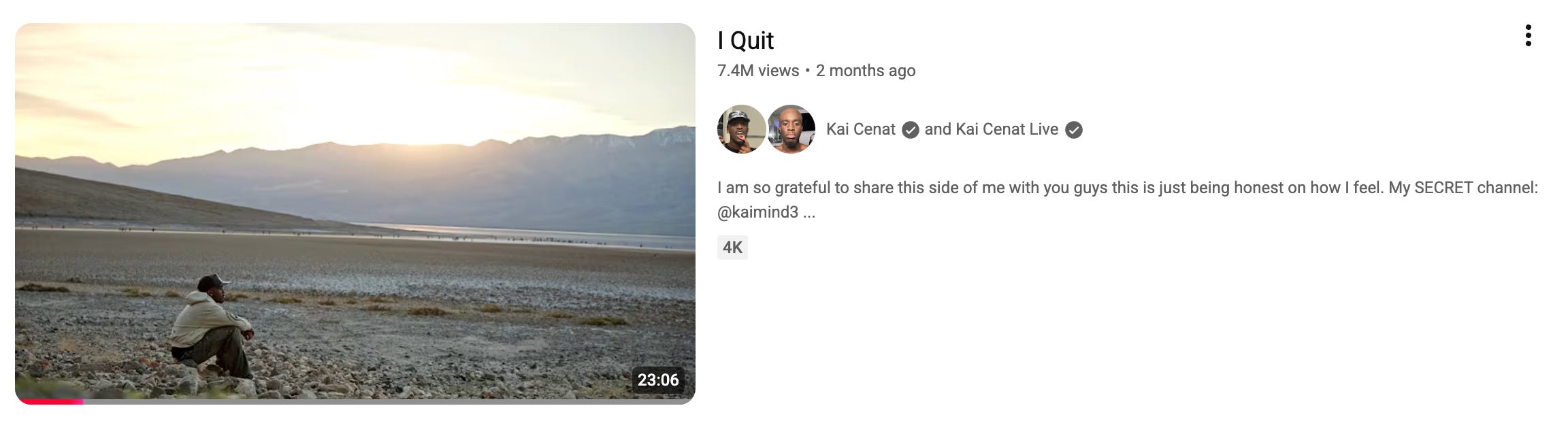
No context. No explanation. Just the two words sitting there, clean and enormous, the kind of title that reaches through the screen and grabs you. The video, along with his acceptance speech at the 2025 Streamer Awards, made one thing clear: Kai was done with streaming (for now?), and wanted to pivot to a career in fashion.
Scan to another point in the cultural landscape and you’ll find Charli XCX. Somewhere in the long exhale after her last album, brat, made her artist of the year, Charli said she wanted to act—not just as a footnote to her music career, but as a full departure from it. She wanted to leave the room she spent an entire decade filling. But that wasn’t the agreement. She was supposed to keep making music, because that was the agreement. An unspoken, unsigned, yet entirely real one in the minds of the audience; the kind of agreement that fame writes on your behalf while you’re too busy becoming famous.
Neither of them asked for our opinion. We formed it anyway. The internet did what it does best when someone walks out of a room that was built around them—it split. Half the comments were full of grief. The other half were something quieter and harder to name: a kind of readiness, predictions already loading, like the collective clearing of a throat.
The reaction was loud, but what it missed was context. Because Kai and Charli are not the story. They’re just the most visible version of a story being told simultaneously, quietly, by millions of people who will never trend. A story that lives in resignation letters and unanswered LinkedIn messages and the private moment when someone looks at their life and begins, for the first time, to read the fine print.
American Dreamin’
To understand what people are walking away from, you first have to understand what they agreed to: The American Dream
The American Dream was never a simple promise of success. It was a contract. A loyalty agreement between the individual and the system, with terms that were never written down but were understood by everyone who grew up inside them. The terms went something like this: you stay legible, you stay consistent, you defer your gratification, you give the system your most productive years, and in return the system will give you security, status, and the quiet dignity of upward mobility. A house, a pension, the comfort of knowing that your children would have it better than you did, maybe even a gold watch at the end.
It was a room society built and told you to be grateful for. And for a long time, enough people were. The room held. The contract was honored, more or less, for long enough that it has become the architecture of an entire culture—the foundation of how we understood ambition, loyalty, identity, and worth. You were what you did. You were where you worked. You were even how long you stayed.
And the system didn’t just reward loyalty. It moralized it. Staying became a virtue and leaving became a character flaw. Job-hopping was irresponsible and quitting was giving up. The pivot was something that needed to be explained and justified, preferably with evidence that your new thing was already working before you abandoned the old one. Oftentimes, it seems that the burden of proof sits entirely with the person leaving, never with the room they’re leaving behind. All of that moral weight — the virtue of staying, the shame of leaving — only holds if the room was worth it. The contract, it turned out, had an expiration date. Nobody announced it.
A Generational Counter-Offer
The contract didn’t break all at once. It eroded.
It eroded when pensions disappeared and were replaced with 401(k)s that quietly transferred all the risk from institutions onto individuals. It eroded when wages stagnated for decades while demand for productivity rose high and the cost of living rose even higher; when the math stopped mathing and everything that made the contract work stopped adding up. It eroded when housing became unreachable for an entire generation that had done everything it was told to do: got the degrees, took the entry-level jobs, paid the dues, waited their turn. It eroded when the Great Recession of 2008 made plain, in a way that could not be unseen, that the institutions underpinning the contract would protect themselves long before they protected the people who had honored it.
The system had changed the terms without issuing an amendment.
Today, only one in four Americans believes they have a good chance of improving their standard of living—the lowest level recorded since that question was first asked in 1987. Nearly half say the American Dream was once achievable but no longer is. Among young people, 86 percent say they still want it and believe in the idea of it, but feel the system is stacked against them. What you are looking at, in those numbers, is not pessimism. It is a damage assessment. It is people who were handed the contract, read it carefully, looked at the fine print and everything it delivered for the people ahead of them, and concluded that the terms were no longer what they were advertised to be. The room was the same. The promise attached to it was not.
What gets called a trend is actually a generational counter-offer.
Quiet quitting. The Great Resignation. Bare Minimum Monday. Lazy Girl Jobs. Job-hopping. The soft life. The pivot. Each of these was reported as a behavioral quirk, a generational pathology, evidence of a workforce that had grown too soft or too entitled or too distracted to honor its commitments. Each was framed as a problem to be solved, a gap to be closed, a generation to be corrected. None of them were treated as what they actually are: the cumulative, distributed response to a contract that the other party broke first.
Gen Z watched their parents grind for decades in exchange for a security that quietly evaporated. They watched Millennials do everything right—the degrees, the hustle, the loyalty, the dues—all to still get priced out of housing, buried in debt, and laid off anyway when the quarter turned bad. They entered the workforce during a pandemic that dismantled every assumption about where work happened and what it was for. They are not leaving jobs because they lack ambition. They are leaving because the job doesn’t point toward anything they were promised. They are, by every available measure, the most goal-oriented generation in the workforce. They have simply stopped accepting that the goal has to be the one the room was designed around.
This is not disengagement. It’s clarity. The realization is not “work is bad.” The realization is that for this arrangement, on these terms, in exchange for promises that are no longer being honored, the answer is simple: no. That is a different and deeper truth entirely, and it’s being delivered quietly, at scale, by people whose names will never trend. Kai and Charli are simply the ones that the algorithm made visible.

The Watcher
Which is why the reaction to them is worth examining so carefully. Because while they’re walking away, everyone else is watching.
Most of us have already formed a prediction. We’ve decided, without sufficient information, whether or not Charli has the range for a sustained acting career, or whether Kai’s fashion ambitions are a genuine creative pursuit or a phase dressed in ambition’s clothes. Some are quietly rehearsing what they will say if these two fail: the sighs, the I-told-you-so’s, the memes, and more. If they succeed, some will claim they believed in them all along, because that is also something people do.
But the discomfort of watching them leave the thing we love them for isn’t really about Kai or Charli. It is, however, about the calculation the rest of us made. The people still in these rooms—who deferred their own dream, who accumulated tenure, who kept honoring a contract they suspected didn’t work for them—are not simply watching a celebrity pivot. They’re watching their own reasoning questioned in public. If quitting at the peak is rational, what does that make staying? If the room wasn’t worth it for someone who had every advantage and every reason to remain, what does it mean for the people who stayed for less?
The unlived life watches the lived one very carefully. And not always with pure generosity.
The commentary that shows up as concern for the careers of others is sometimes the discomfort of watching someone act on a conclusion we have already privately reached but haven’t found the runway, or the courage, or the financial margin to act on ourselves. The grief in the comments isn’t only for the artist. Some of it is for the version of us that decided the room was worth staying in—and is still, quietly, running the numbers.
It’s true that we don’t know yet how Kai’s pivot unfolds, or what kind of actor Charli becomes, or whether the lives they’re building will hold them. But that not-knowing is not a gap in the story. It is the story. They made their departure while the applause was still happening—before certainty arrived, before the reviews came in, before anyone offered permission—and that timing is not recklessness. It’s what it looks like when someone decides their own becoming outranks your need for their continuity.
The system failing and the response being personal are not two separate things. They are the same event, viewed from different distances. From a bird’s eye view, you see a cultural shift—data points, trend headlines, a generation being studied and diagnosed. Look closer, and you’ll see a person sitting with the quiet realization that the rooms they are in were not entirely chosen. That the loyalty they have been performing is part genuine and part inertia. That the contract they have been honoring has terms they were never shown.
The point of all this is not an instruction to quit. It’s not a manifesto for the pivot or a permission slip for the walkaway. It is actually something more uncomfortable yet more useful: an invitation to read the terms of your own arrangement honestly, perhaps for the first time. To ask what you are staying for, and whether the answer is still true. To notice the difference between a room you built and a room you simply never left.
Think about the version of you that other people are most certain about. The role that has defined itself in their minds over years of consistent performance. The dependable one, the ambitious one, the one who stayed in their lane and made it work. Think about the room that version of you lives in. Who built it? Were you consulted? Because somewhere in the accumulated weight of other people’s certainty about who you are, there is probably something you put down–a version of yourself, an ambition, a dream–and forgot you were ever carrying.
The outcome for Kai and Charli is still unknown.
So is yours.
Gawd. This is my favorite piece on transition I’ve ever read, (and I even wrote an autobiographical one of my own). What you said about the unlived watching the ones living… that should be a whole galleryyy. Thank you for this, I will be chewing on this piece for a while.
🖤