
Life's A Gamble.
Sports betting, the stock market, dating apps, and Ozempic—and the one thing we're all actually looking for.

The NBA Finals are finally here. The Spurs, looking to recapture the dynasty that defined the early 2000s while launching what could be one of the greatest careers this league has ever seen. The Knicks, a storied franchise chasing its first championship in over fifty years, trying to give a city back something it's been waiting a long time for. No matter who you're rooting for, this has been some of the best postseason basketball we’ve seen in recent memory. And I can't watch a game without being sold a bet.
Throughout the playoffs, it’s been nonstop. DraftKings. FanDuel. BetMGM. Between quarters, during timeouts, in the crawl at the bottom of the screen. The same sport has been repackaged as something you can have action on. The league (and every other major league) has made its position clear: betting doesn’t just belong around sports, it belongs inside it. Nielsen projected the NBA stands to gain $585 million from legalized sports betting ($4.2 billion if we count all four major sports leagues), with $160 million paid directly from gambling operators in sponsorship & advertising fees, and the other $425 million baked into the fan engagement that betting drives. The league didn’t just stumble into this jackpot of a relationship either. It built towards it.
Which makes what happened in October a little harder to look past.
Earlier this season, six men — including current and former NBA players — were indicted on federal charges of wire fraud and money laundering conspiracy. The allegation: they had used non-public information about upcoming NBA games (pre-release injury reports, lineup decisions, etc) to place fraudulent sports wagers. Among the defendants was Terry Rozier, then an active player for the Charlotte Hornets, who allegedly tipped associates that he planned to leave a game early. Over $200,000 in bets were placed on his underperformance. He exited after nine minutes. The bets paid off. (justice.gov)
So, let me get this straight. The league promotes betting to its audience. It profits from the betting infrastructure. Meanwhile, it prosecutes its own players for betting with information the public didn’t have? Interesting.
The contradiction is easy to spot but it only tells us something about the league. The harder question is why the rest of us keep betting anyway; knowing what we know, and seeing what we see.
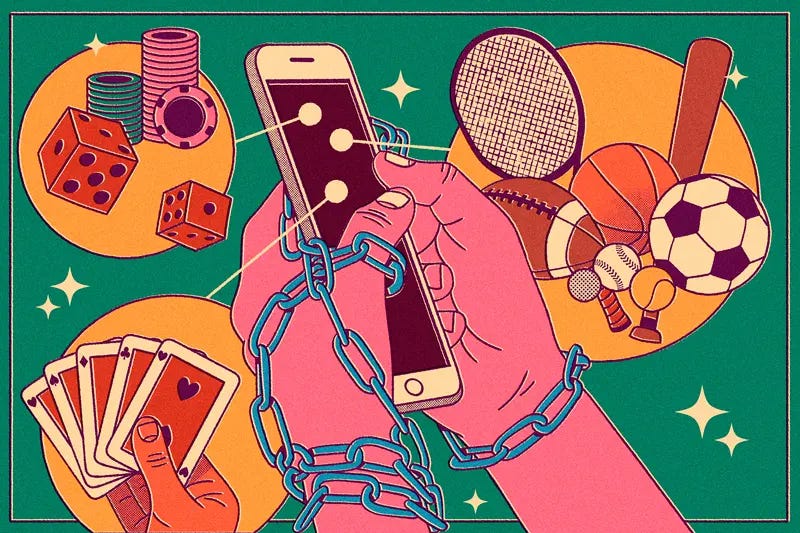
This isn’t a gambling problem. Gambling is just where the pattern is most visible right now.
More than 1 in 5 American adults admit to sports betting. The market is projected to reach $200 billion by 2030. Yet approximately 95 percent of sports bettors lose money. The gap between participation and probability is enormous. And it’s only getting bigger.
But we can’t stop there. Look at where else this pattern shows up:
Prediction markets — platforms where real money is wagered on elections, events, economic data, geopolitical outcomes, and more — have gone from fringe curiosity to mainstream. Polymarket handled over $700 million in volume during the 2024 election cycle alone. These are not casinos. The people using them are educated, often professional, often deeply informed about the subjects they’re betting on. They are, by every traditional measure, “sophisticated.” And they are still ending up on the wrong side of the odds more often than not.
Then there’s day trading. Retail investors, about 10 percent of daily equity trading volume a decade ago, now account for more than 20 percent. Roughly 97 percent of them lose money.
It doesn’t stop there, either. The same architecture shows up in dating apps, where behavioral researchers have explicitly compared the match-rate mechanics to slot machines: variable reward schedules, the same pull-and-maybe logic, the same compulsion to go one more.
It even shows up in Ozempic: millions of people who’d been told for decades that their bodies were a discipline problem finally had access to something that worked differently than the system said things should work. They took the shortcut; not because they misunderstood the slow way of doing things, but actually because they’d already tried the slow way of doing things. (NAIFA)
The conventional explanation for all of it is the same: people don’t understand the odds, or the dopamine loop is too powerful, or the apps are too frictionless. But that explanation requires you to believe that millions, maybe even billions, of people across every one of these behaviors, are simply confused.
I don’t think they are. Here’s the truth:
We don’t bet because we think we’ll win. We bet because the bet is the only place left where we get to decide.
The people loading Robinhood and placing parlays and swiping through dating apps are not confused about probability. Many of them came of age after 2008, watching institutions get bailed out while families absorbed the damage. They carry student loan payments into their thirties. They’ve watched wages fail to keep pace with what housing costs, what food costs, what childcare costs—aka what life costs. They’ve looked at the math on the conventional path — save slowly, wait patiently, hope the market cooperates — and correctly determined that it doesn’t clear the bar.
So when it comes to things like gambling, the math on the bet is bad, sure. But at least the bet is theirs.
The bet is not primarily a financial instrument. It’s an assertion, an affirmation, and manifestation all at once. It’s a person reaching for authorship over their own situation at a moment when the conventional mechanisms for doing that have either stalled or closed. Platforms like Robinhood didn’t just expand access to trading — they gamified it, made it feel like something a person could win. But that framing misses what the gamification was actually selling. It was never the promise of wealth. It was the promise of participation. The promise that you, specifically, with your read of the market, could pull a lever and have something happen. In a world where most of the levers are either out of reach or rigged, the ability to pull one is worth something independent of the outcome.
This is why the NBA situation cuts deeper than a league’s hypocrisy. The league built over a half-a-billion dollar revenue stream on the premise that fans should have action on games. It sold the idea that your read, your instinct, your stake in the outcome matters. And then it prosecuted the people inside the system who found an actual edge, who had real information, for using it.
The house didn’t ban betting. It banned winning too well.
Because the entire architecture depends on a specific imbalance: you get to feel like you’re playing, and the odds ensure you mostly lose. The moment someone tilts that balance — even using information they came across honestly, through proximity, through relationship, through their own body — the system reasserts itself. Indictments. Twenty-year maximum sentences. Federal courthouses in Brooklyn.
In other words, the house always wins. Not by accident, but by design.
This is what the betting boom is actually telling us, if we’re willing to hear it. It is not a story about addiction or irrationality or financial illiteracy. It is a story about what people do when the systems built to deliver security and agency have quietly stopped delivering either. When the 401k math doesn’t work, when the housing market is closed, when the body you were told to accept doesn’t have to be accepted anymore — you find the bet. You find the place where your decision still means something, even if the odds say it won’t.
That’s not irrational. That’s completely human.
Life’s a gamble. We’ve always known that. What’s changed, however, is that for more and more people, the gamble is starting to look like the only honest game in town.
Great read!!!